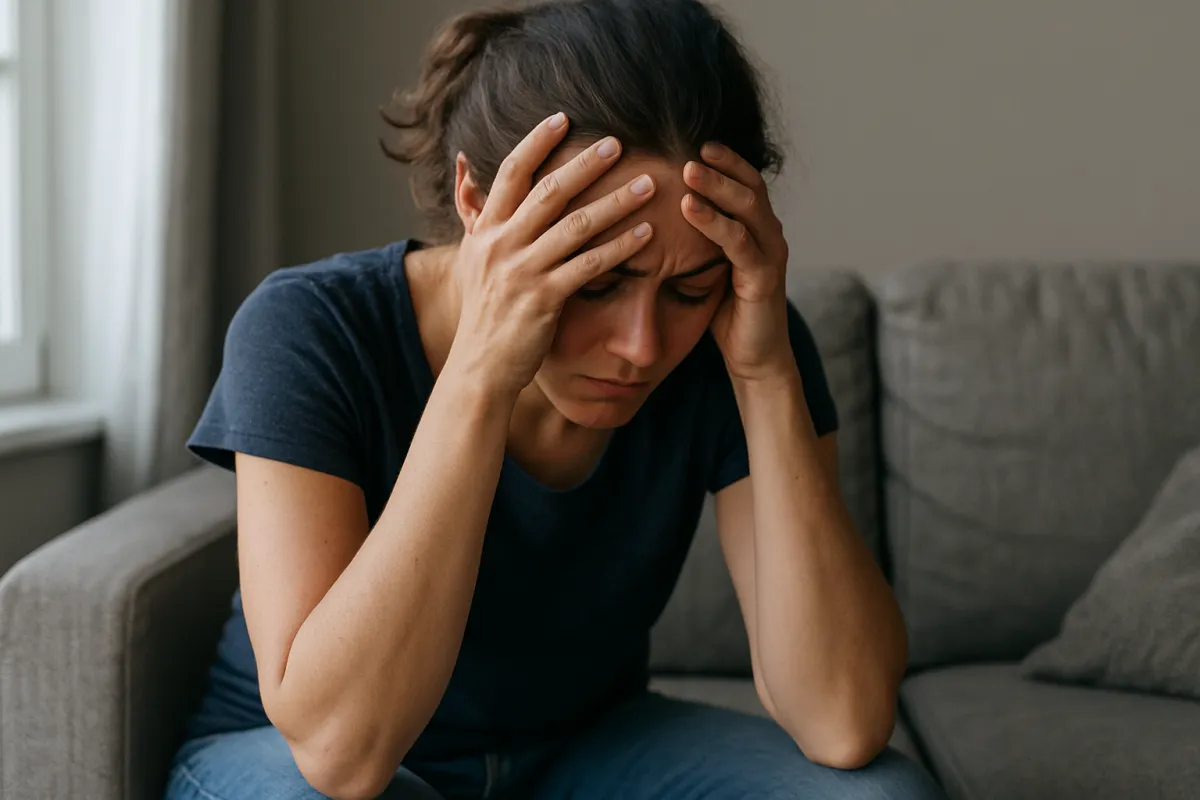
Stress
Why Stress Feels So Normal - And Why It Still Overwhelms Me
A personal reflection on biology, beliefs, and the stories we tell ourselves

Stress has become one of the most familiar emotions of our time. And somehow, at the same time, one of the most misunderstood.
We talk about stress as if it comes from the outside - from deadlines, responsibilities, difficult emails, full calendars. But when we look closer, something much deeper begins to reveal itself:
👉 Stress is rarely about what happens. 👉 Stress is about how we interpret what happens.
And when I look at the last 8-10 years of my own life, I see this clearly.
For years, I moved with extremely high stress patterns - consistently measuring 7-8 hours of stress activation per day, often sleeping only 4-5 hours per night. I pushed myself, built, created, performed, delivered.
And my body kept score. My gut microbiome fell out of balance. My skin reacted strongly, and over the years a very aggressive rosacea developed.
This was the moment I began to look deeper - not only at biology, but at beliefs, patterns, and interpretations.
In a recent conversation with AI (you can listen to it here on my blog), we explored exactly this: What stress really is, what it does to the body, and how much of it is shaped not by “pressure,” but by our internal narratives.
Let me walk you through what we uncovered - and how it connects to my own story.
1. Stress is normal… but our world is not
Biologically, stress is ancient. It was designed for clear, physical threats:
cliffs
predators
storms
survival moments
Our ancestors ran, climbed, fought, moved. Their bodies activated - and then released.
Today our triggers are different:
emails
expectations
messages
performance pressure
thoughts
imagined scenarios
But our biology reacts exactly the same - only (often) without the physical release.
So instead of 2-3 minutes of stress, many of us live in hours of activation without interruption.
2. The body doesn’t lie
Even when the mind says, “I’m fine,” the body shows the truth:
faster heart rate
shallow breathing
cold hands
tight jaw
tingling skin
digestion slowing down
cortisol staying high
I know this pattern intimately. It was my daily reality for years.
3. Why we stress even when “nothing is wrong”
This is one of the most powerful insights from the conversation:
👉 We don’t experience the world as it is. 👉 We experience the world as we interpret it.
You can sit calmly in an office, imagine stepping out of an airplane while skydiving, and your body will instantly react.
There is no lion. No danger. Just interpretation.
And the interpretations are learned:
“I must be perfect.”
“I have to deliver.”
“I can’t slow down.”
“I need to prove myself.”
“I shouldn’t rest.”
These are not external stressors. They are internal rules.
And in my case, these rules drove my stress patterns more than anything else.
4. My personal turning point - biology and belief
When I saw, black on white, that my gut-microbiome is strongly out of balance and my skin was painfully inflamed, that was a trigger, strong enough to start:
fixing sleep
optimizing routines
changing nutrition
supporting the gut
regulating inflammation
understanding the liver–skin connection.
And these things matter deeply. They are the reason my gut microbiome is finally in a better place. They are the reason I now support my liver (I learned about the skin-lever connection).
But the deeper shift comes from this understanding:
👉 My biggest stressor was not the world. 👉 My biggest stressor was my interpretation of what I “should” do. - This is often obvious, if we consciously observe other people in the same situation. Not everybody reacted the same as I was, and looking back all this makes a lot of sense to me.
This is what I am working on now. And it is changing everything.
5. Borrowed stress - and why sensitive people feel it even stronger
Many of us don’t only carry our own stress. We absorb:
emotional atmospheres
the stress of partners
the pressure in rooms
unspoken tension
the energy of clients
expectations of others
If you are empathetic or intuitive, this can be overwhelming.
But awareness is the first step to shifting from reaction to response.
I speak about this in the AI conversation.
6. Why small habits aren’t “the solution”… but still essential
Meditation, breathing, stretching, yoga, movement - I practice all of these. I know how to meditate. I use frequency tracks that calm my system. I stretch. I exercise because I love it. I connect with people because it grounds me.
Are these small habits enough on their own? Not yet for me.
But they create the space in which deeper change can happen.
And deeper change means:
changing interpretation
changing the story
changing the automatic reaction
choosing differently
valuing yourself enough to stop when your body whispers
That’s the real work.
7. My commitment - to myself, and to anyone who resonates
I’m giving myself this promise: for the next 4 months, no matter how full my schedule is or how ambitious my goals are, I will choose the small, simple practices that keep me connected to myself.
meditation twice a day
one relaxation session
stretching and yoga
movement
emotional awareness
connection
rest without guilt
Because I want to experience what happens when interpretation softens. When the system can breathe. When the body feels safe again.
And maybe you want to explore this with me.
8. A world where stress doesn’t define us
Imagine a world where children grow up learning:
mistakes are part of learning
performance doesn’t define worth
rest is strength
emotions are signals
awareness is normal
connection matters more than perfection
A world where adults model self-compassion. Where we understand our biology and our beliefs. Where stress isn’t glorified. Where the body doesn’t have to fight every day just to function.
This is the world I want to help build. Through health, through ownership, through human-centered AI, and through the conversations we are willing to have.
You can listen to the full AI conversation here in my blog.
A question to leave you with
What interpretation creates the most stress for you today - and what would shift if that interpretation softened, even a little?
Be well
Tina
